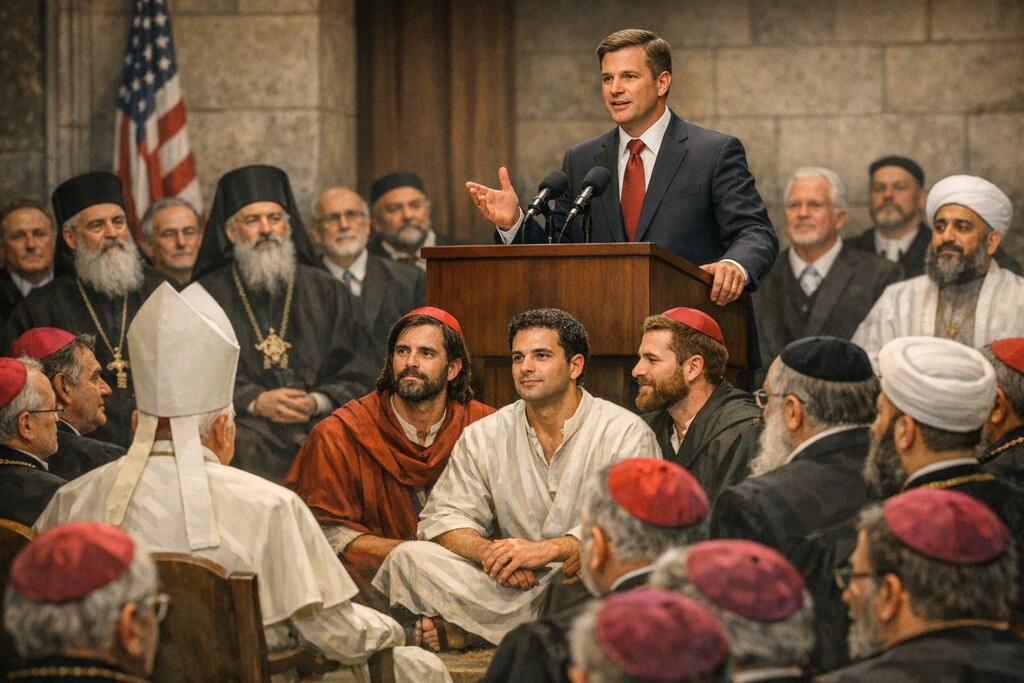
Politics and Religion
If we look back through history, we see that in the earliest periods there was no distinct concept of politics, societal conduct was strictly directed through guidance and obedience to God. But as humanity multiplied, God established a covenant with the Israelites, articulated through Moses, that linked obedience to divine commandments and introduced the concept of supervising social behavior. This covenantal framework still reinforced the belief that governance should reflect and uphold divine will.
The population continued to increase, and Moses found himself responsible for both the social and religious decisions for the entire community. His relatives recognized that this burden was becoming too great for just him, and in Exodus 18:21 they advised him:
‘But you should also look among all the people for capable persons who respect God. They should be trustworthy and not corrupt. Set these persons over the people as officers of groups of thousands, hundreds, fifties, and tens. Let them sit as judges for the people at all times.’ (Exodus 18:21)
This moment represents one of the earliest examples of delegated leadership, where representatives were appointed from among the people, and marks the beginning of a judicial structure in which appointed judges presided over the various communities and districts, thus the introduction of politics.
Moving forward to the period of King David, his reign continued to be understood as divinely sanctioned. God established David’s authority and promised that his descendant would ultimately hold complete authority over Israel. David’s governance consistently relied on divine guidance signaling that political leadership operated under divine oversight. As a result, any disobedience or disloyalty toward David or his appointed officials could be interpreted as disloyalty to God Himself, further reinforcing the deep interconnection between religious devotion and political allegiance. David now appointed judges and politics was in full swing.
Centuries later, as governments evolved and authorities changed, various municipal institutions appeared promoting secular governance and the religious communities began to adapt accordingly. Evolving through time together, religion and politics became
increasingly intertwined, to the point where government officials and religious leaders regularly consulted one another on matters of regulation and control.
By the time Jesus entered the historical scene, Roman civic authorities and the Sanhedrin had formed what many would view as an uneasy, and mostly corrupt alliance. Corruption within the temple system had become so widespread that Roman officials even influenced the appointment of Pharisees and other temple leaders, selecting individuals based on political favor rather than spiritual merit.
This dynamic completely blurred the boundaries between religious authority and political influence, further eroded what little integrity the temple governance had.We can fully understand why Jesus frequently clashed with the religious elites. The temple had become saturated with Roman influence and impious traditions, functioning more like a marketplace for merchandising than a place of genuine spiritual devotion.
Jesus recognized the need to distinguish civil authority from spiritual responsibility, and he recognized the temple leaders were manipulating and misinterpreting Scripture to serve their own interests and to maintain favor with their new political allies. He would eventually address these issues directly with the Pharisees.
Jesus did not necessarily confront the political issues directly; instead, he focused more on the injustices and inequalities that often resulted from them. He recognized that civic responsibilities and spiritual duties could not always be blended, as they sometimes travel in fundamentally different directions. His cleansing of the temple illustrated this point vividly, showing that attempts to merge social, economic, and religious interests would only corrupt genuine worship and this comingling had to stop.
Jesus recognized that the alliance between the Roman officials and the temple authorities was untenable, and that political entanglements had no rightful place within the genuine pursuit of God’s word. When the Pharisees attempted to trap him by handing him a coin with Ceasar’s picture on it, and asking him a question about paying taxes, he crossed the Rubicon. He used the moment, once and form all, to illustrate the necessary distinction between earthly governance and spiritual duty, responding to them;
“Render to Caesar the things that are Caesar’s, and to God the things that are God’s” (Mark 12:17)
Affirming that civic responsibilities and devotion to God occupy different realms. In doing so, he also offered an early articulation of what would be understood eons later as the separation between “church and state.” Generally speaking, political hyperbole and spiritual truths don’t align.
Whenever alliances form between religious authority and political power, the results are often problematic. Consider the relationship between the Herodians and the Pharisees. In Mark 3:6, after Jesus healed a man on the Sabbath, an act that infuriated the Pharisees, they immediately sought out the Herodians, a political faction aligned with Roman interests, to discuss how they might eliminate him. This unlikely partnership shows how religious leaders can easily become corrupt when entangled with political leaders, who are more than willing to compromise their own principles in pursuit of control.
I see very few instances when political ambition is comingled with spiritual duties, and the result ends up being the complete edification of the word of God. It appears the founders of our country understood this nuance in so they created a moratorium of the comingling of religion and politics. To serve man and a deity at the same time is a tricky proposition and more than likely, you’ll chose one over the other. So the founders decided it’s best to leave the governance of the country to the politicians and the guidance of the souls of the people to the clergy, thus the division between church and state.
Conclusion
Throughout history, politicians have often sought the support of religious communities, recognizing that many people place deeper trust in their spiritual leaders than in the civic officials meant to represent them. Religious communities offer moral authority, social
cohesion, and a unified voice, making their endorsement a powerful political asset Jesus appeared to regard this idea as misguided, understanding how easily it could unravel into deeper problems.
Whenever spiritual authority is fused with political aspiration, divided loyalties and compromised intentions are almost certain to follow. Jesus echoes his sentiment in Matthew 6:24:
“No one can serve two masters. Either you will hate the one and love the other, or you will be devoted to the one and despise the other. You cannot serve both God and mammon.” (Matthew 6:24)
His words highlight the inherent conflict that arises when religious devotion is mixed with worldly power, reminding us that divided allegiances rarely lead to integrity I do not think we need to look very hard to see the obvious parallels to the religious and political comingling happening today and how all of this sounds so eerily familiar.
‘Every person should place themselves under the authority of the government. There isn’t any authority unless it comes from God, and the authorities that are there have been put in place by God.’ (Romans 13:1)
‘You shall have no other Gods before me’ (Exodus 20:3)